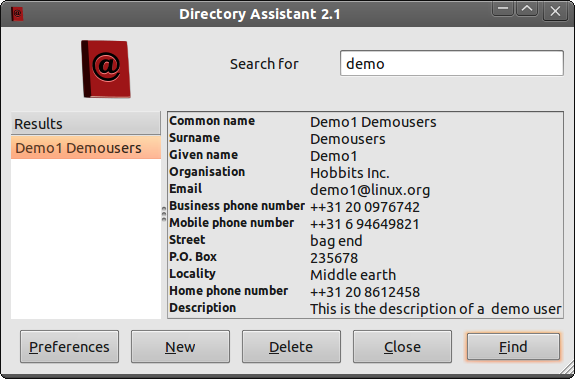
When you double-click the found entry you can edit the entry:

Directory Assistant is a small application for managing a LDAP address book. The focus is to create a very easy to use program, with only the few but necessary features. The target is novice users that have their addresses in an LDAP server.
February 3 2026: Directoryassistant 3.1 released!. After a long development pause, there is a new release that fixes a bug in the Makefile.
Debian includes Directoryassistant in the latest version, so Debian users should be able to install Directoryassistant using apt.
This is a screenshot from version 2.1:
When you double-click the found entry you can edit the entry:
Directoryassistant 3.0 uses python3, gtk3 via gobject-introspection and python-ldap:
Unpack the tarball, cd directoryassistant-3.1/, edit the Makefile (by default it will install in prefix /usr/ but you can change that with the prefix line in the Makefile) and run sudo make install.
Configuration is done by config file, but since 2.1 this ia also possible from the GUI. The config file is very simple. An example is shown below:
[My Ldap Server]
ldapurl = ldap://your.ldap.server.com/
bind_dn = cn=someaccount,o=someorg
bind_password = yourpassword
base_dn = ou=department,ou=People,o=someorg
startup_search = myfamilyname
add_dn = ou=myunit,ou=department,ou=People,o=someorg
The config should be stored in /etc/directoryassistant or $HOME/.directoryassistant
There is very little development on directoryassistant, it just works.
There is a CVS repository in which the development versions are available
Bugs can be reported in our bug tracker.
You can contact me at olivier (at) bluefish dot openoffice dot nl
Copyright © 2003,2004,2005,2006,2007,2008,2009,2010,2011,2020 Olivier Sessink
